Raising
a Skepchick
Darcie Hodgkins
Langone
 When
my daughter was born, I vowed never to lie to her, never to create
a set of untrustworthy myths and religious beliefs that could fail
her when life became unbearable. For the most part, I have kept my
vow. There have been a couple of messes along the way (“Of course
I believe in Santa Clause. You wouldn’t lie to me,” says
she) , times when I was not entirely sure whether I was telling her
the truth or not, and the time I told an outright lie, betraying my
goal.
When
my daughter was born, I vowed never to lie to her, never to create
a set of untrustworthy myths and religious beliefs that could fail
her when life became unbearable. For the most part, I have kept my
vow. There have been a couple of messes along the way (“Of course
I believe in Santa Clause. You wouldn’t lie to me,” says
she) , times when I was not entirely sure whether I was telling her
the truth or not, and the time I told an outright lie, betraying my
goal.
Here is the thing: I don’t believe in heaven. I do not know
if there is a God, I am not sure where I stand on karma, and I cannot
wrap my mind around the idea of Hell. I know that humans are minute
beings in an immense universe and that I don’t have to know
all the big answers— but that the search for those answers is
fun. I think the Christian concept of God stands on a shaky foundation,
and that the idea that children pick their abusive parents in order
to “work through their karma” is offensive. All these
things and more I have discussed with my kid. By seven years of age,
she made the informed decision that Manichaeanism made the most sense
to her; obviously, there are two gods fighting it out somewhere.
It is reasonably uncomplicated to plant in your child the intellectual
curiosity needed to pursue a skeptical life—just talk to him
or her consistently and don’t dumb anything down. A problem
arises however, when the child leaves the sphere of the rational and
requires an answer to meet a different need, a core need. It was late
one night and I was tucking my little girl into bed after a long day
filled with guests and the rainy, windy weather for which Seattle
is known. She was exhausted, as was I. We were snuggling and burrowing
when she burst into tears and asked, “What will I do when you
die, Mommy?”
Boom! I lied. Before I could think it through, I was desperately dragging
us both away from the psychological abyss of what I believe and she
suspects—dead is dead. I cannot go there with her—the
thought of leaving her alone in this world is not something I can
think about with sanity and obviously, neither can she. I told her
that when Mothers die they spend eternity standing right behind their
child, watching over him or her until the child also dies, and so
on through the cycle of life. I heard myself speaking and immediately
my conscience began to question my answer, but I knew my motive.
Anyone who tells you it is easy to raise a child is either crazy or
a liar. It was not just that I was afraid for her ability to sleep
that night. I was afraid for her, period. Is it right for me to teach
her to question everything, to take always the stance that anything
that seems too good to be true probably is and that there is no big
daddy in the sky who will take her troubles away? What resources will
she draw from when I am no longer here?
Life is arduous and it is not for me to take a spiritual resource
from anyone. If believing in God helps someone make it through his
or her long, dark night of the soul, well, that is not for me to judge.
It is my job to prepare my child for her life though, and I think
that a skeptical mind will help her survive the challenges ahead.
Maybe it’s not so uncomplicated to prepare a child for a skeptical
life after all.
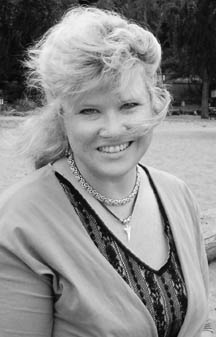
Darcie
Hodgkins Langone is a writer and grad student living in Washington
State. When she is not at her day job, editing publications for a
community college, she can usually be found lecturing her children
on developing morality without religion or looking for a place to
hide and read a good book.